
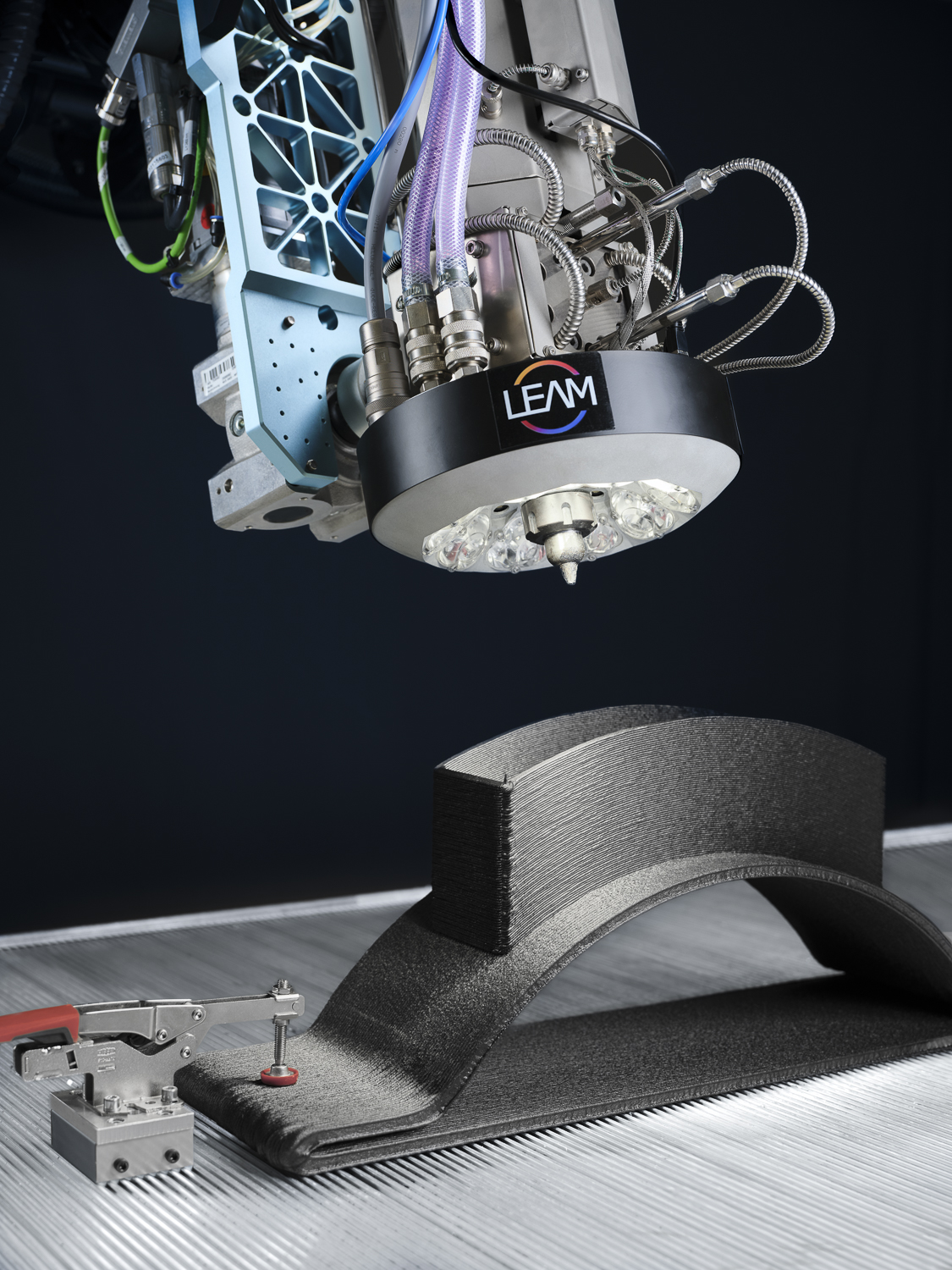
Make the material’s strength useful in the part.
A printed part needs to carry loads across its layers as well as along them. If the layers separate before the material itself reaches its limit, extra wall thickness or reinforcement can become a workaround for the bond.
For most polymers, LEAM can achieve material properties at the level of compression-molded bulk material, provided the extrusion is high quality and pore-free. With unreinforced polymers, this can include isotropic mechanical properties: comparable performance in different directions.
That gives you a route to the properties your design already calls for. Compare the same material grade and test conditions, then use the result to decide which design compromises you can remove.
A longer layer time need not mean a weaker bond.
On a large part, the nozzle may take a long time to return to the same spot. The previous layer cools while it waits. Raising the melt temperature alone does not give you control over the temperature of that surface.
LEAM heats a thin film at the surface just before the next bead arrives. The bulk below can stay stable while the surface is prepared for bonding. This enables longer paths and larger parts, and lets you plan pauses for inserts, machining or inspection before continuing the print.
See how surface and bulk temperatures work together
Published LMPAEK trials
What did temperature control change?
- Unreinforced LMPAEK: +457% Z-direction ultimate tensile strength when the programmed layer temperature increased from 300 to 340 °C.
- Reinforced LMPAEK: +70% Z-direction ultimate tensile strength when comparing uncontrolled printing with a programmed layer temperature of 340 °C.
These results belong to the reported materials and comparison conditions. Use tests on your material and process to establish the properties for your design.
Read the LMPAEK studyPublished PA6-CF trials
Stronger bonds beyond the unheated surface-temperature limit.
In trials on PA6 with 40 wt% carbon fiber, localized surface heating increased tensile strength and elongation at break over the reference printed without local heating.
That reference already used the highest surface temperature achievable without local heating in the process. The improvement therefore came on top of that warm starting point. Heating a thin surface film adds room to improve the bond while the material below stays stable.
Read the PA6-CF studyDesign for the loads the part will see.
For a tool, that can mean lifting, clamping, demolding and repeated production cycles. For a structural part, it means the loads it will carry in service. Better bonding matters when it helps the part withstand those demands.
In the materials we have tested, we have also seen strong increases in impact and fatigue performance. Test the properties your application needs with the wall thickness and geometry you intend to use. You can then judge whether stronger bonds allow a lighter design, a larger part or a longer working life.
- Impact and fatigue: what have we tested? ↗More on performance under repeated and impact loads.